Clearing a Rented Villa in Dubai: What Goes and What Stays
The Junk Services Dubai Team 6 min read
Most of a rented villa's contents are obvious. The argument, where there is one, is about the built-in wardrobes, the kitchen units, the shed at the end of the garden and the shelving somebody screwed to the garage wall. This guide sets out where the line usually falls between a tenant's belongings and the landlord's property in a Dubai villa, and what to settle in writing before a crew starts unscrewing anything.
Why a Rented Villa Is Harder to Clear Than a Rented Apartment
In an apartment the boundary is short. There is a fitted kitchen, usually a set of built-in wardrobes, and the rest of what you can see is yours. A villa moves that boundary a long way outward, because the property includes a garden, a driveway, a garage and often an outbuilding or two, and each of those has fixed elements of its own.
The second difference is time. Villa tenancies in Dubai tend to run longer than apartment ones, and a household that has been in the same villa for six years has usually added things to it. A shade sail goes up over the terrace, a shed appears at the side of the house, somebody plants trees. By the time the tenancy ends, those additions look like part of the property to everyone except the person who paid for them.
Rented apartment
Rented villa
Fixed elements
Kitchen, wardrobes, bathroom fittings
All of those, plus garden, irrigation, external lighting, garage
The garden and anything the tenant installed outdoors
The list of things that might reasonably belong to either party is far longer in a villa.
The Tenancy Inventory Decides It
The inventory signed at the start of the tenancy is the document that settles almost every question here. It lists what the property contained when you took it on, which by definition means everything else arrived with you.
Find it before you book anything. If the villa was handed over part-furnished, the inventory is the only record of which appliances came with the property and which you bought, and six years is long enough for nobody to remember reliably. Where an item is genuinely absent from the list and you are unsure, ask the landlord or agent in writing rather than deciding on the day.
Inside the Villa: What Stays Fixed
The interior list is close to what any Dubai rental would have, and it is the shorter half of the job.
Built-in storage: Fitted wardrobes, linen cupboards and any joinery screwed to the structure. These stay even where you paid to have them refaced or fitted out with extra rails.
The kitchen: Units, worktops and anything integrated behind a cabinet door. A free-standing cooker or fridge you bought yourself is a different matter and leaves with you.
Services: Air conditioning, water heaters, extractors and the water tank are part of the building. None of these are a tenant's to remove, and they are not items a removal crew will touch in a rented property.
Window treatments: Tracks and rails usually stay; the curtains hanging on them are usually yours. Check the inventory, because part-furnished villas often list soft furnishings.
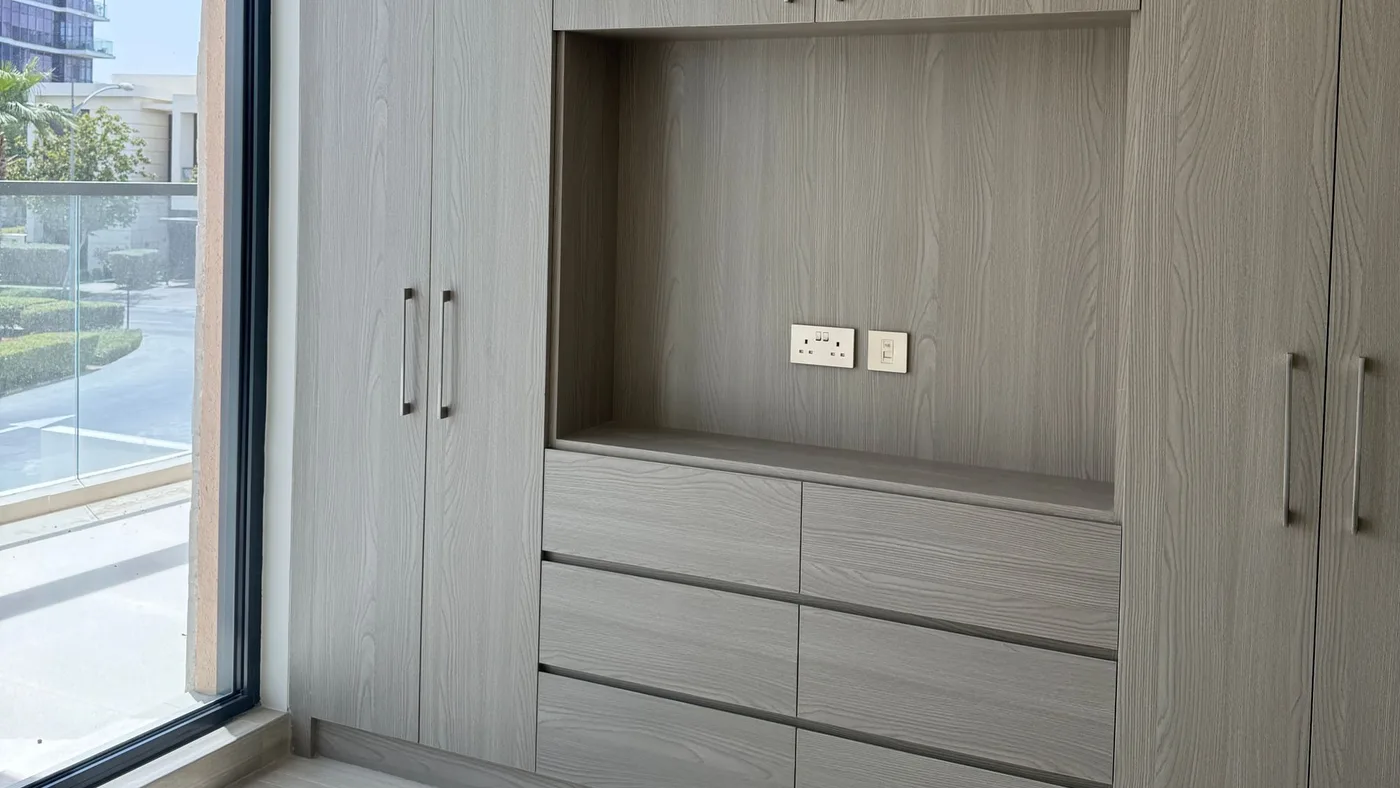
Built-in wardrobes are part of the property. What comes out of them is yours; the units themselves stay.
The Garden Is Where Most Disputes Start
Outdoor space is the part of a villa tenancy people think about last and argue about most. The general rule is that living landscaping and installed systems belong to the property, and free-standing items belong to whoever bought them.
Planting in the ground stays, including trees and shrubs you paid for and put in yourself. Once it is rooted in the landlord's soil it is part of the garden.
Plants in pots are yours, and worth deciding on early because they are heavy, awkward and often the last thing anyone thinks about.
Irrigation lines, external lighting and anything wired or plumbed in stays, even where you installed it.
Garden furniture, parasols, barbecues, play equipment and free-standing planters leave with you.
Decking, pergolas and shade structures fixed to the ground or the building sit in between, and need a written answer before anyone dismantles them.
Dubai summers make this worse than it sounds. Outdoor furniture, plastic storage and rattan pieces degrade quickly in the heat, so a good deal of what is sitting in a villa garden at the end of a long tenancy is no longer worth moving to the next home. That is a disposal decision rather than a packing one, and our garden waste removal service covers the green side of it in the same visit.
A villa handover includes the outside of the property, not only the rooms inside it.
The Garage, the Store and the Maid's Room
Villas absorb storage in a way apartments cannot, and the overflow rooms are usually the ones holding the most volume on handover day. A garage in particular tends to accumulate items that never made it back inside, which is why a garage clean out is often the largest single part of a villa clearance.
Shelving is the recurring question. Free-standing racking is yours and leaves. Anything bolted to a wall usually stays unless the landlord asks for it to come out, and either answer is fine as long as it is agreed rather than assumed. The staff room has its own considerations, covered in maid's room clearance.
Getting the Villa Empty by Handover
The sequence matters more than the speed, because a villa clearance has an outdoor half that behaves differently from the indoor half.
1Read the inventory and mark anything you are unsure about, before you sort a single room.
2Send the landlord or agent a short written list of the items in question and get an answer back in writing.
3Arrange the community gate pass, since villa communities across Dubai want notice before a vehicle comes in.
4Clear the outdoor areas first, because they are exposed, slow to load and the easiest part to underestimate.
5Leave the rooms you are still living in until last, then book the collection for the day the property has to be empty rather than the day you move.
A whole-property job of this kind is a house and villa clearance rather than a single collection, and it is worth describing it that way when you book so the crew and the time window are sized for a garden as well as a house.
What to Agree in Writing First
Anything you installed outdoors that is fixed to the ground or the building.
Any appliance the inventory does not name outright.
Whether wall-fixed shelving and brackets come out or stay in place.
What the landlord expects the garden to look like at handover, since a bare bed and a planted one are different results.
The date the property has to be empty, which is often earlier than the date the tenancy ends.
None of this needs to be formal. A message thread with the agent that shows a question asked and answered is enough to stop a deduction argument later, and it takes an afternoon to put together.
Key Takeaways
Everything fixed to the villa stays; everything you brought leaves with you.
The tenancy inventory is the document that settles disputed items, so find it before booking.
Planting in the ground belongs to the garden even when the tenant paid for it.
Sheds, decking and shade structures need a written answer before anyone dismantles them.
Clear the outdoor areas first, since they are slower to load than the rooms inside.
Why Choose Junk Service in Dubai
As a local, fully insured team, Junk Services Dubai makes clearing your space simple — fast pickups, fair upfront pricing and responsible disposal across every Dubai community.
Same-Day Availability
Book today and, where crews are free, we clear it today — with no rush surcharge.
Fair, Upfront Pricing
A flat price agreed before we arrive, based on volume, items and access. No surprises.
Insured, Uniformed Crews
Background-checked teams who do all the lifting and protect your floors, lifts and walls.
Responsible Disposal
We sort for reuse, donation and recycling in line with Dubai Municipality guidance.
Our editorial team is made up of the crews and coordinators who clear homes, villas and offices across Dubai every day. We share practical, first-hand guidance on decluttering, disposal and responsible waste removal in the UAE.
FAQ
Frequently Asked Questions
Anything planted in the ground belongs to the property, including trees and shrubs the tenant paid for. Plants in pots stay the tenant's and can be taken or cleared with the rest of the load.
Usually yes, if it is free-standing and not built on a poured base. Confirm it in writing with the landlord first, because a shed that has been in place for years is often assumed to belong to the property.
Treat it as unresolved rather than yours. Ask the landlord or agent in writing before the clearance date, since an item absent from the inventory is exactly the kind of thing that turns into a deduction argument at handover.
It depends on what the landlord wants and how it was fixed. Anything wired or plumbed in normally stays. A bolted-down pergola can go either way, so get a written answer before arranging removal.
No. Water heaters, tanks and installed air conditioning are part of the building in a rented villa, and a removal crew will not disconnect them from a property you do not own.
Yes, and it is often the better approach. Outdoor areas, the garage and any storeroom can be emptied in one visit well before handover, leaving only the rooms in daily use for a final collection.
No. The crew works from what you point out and never rules on ownership. Anything you have not resolved with the landlord should be set aside rather than loaded, since an item removed by mistake is difficult to undo.
Final Thoughts
A villa clearance goes wrong in the garden far more often than in the house. The rooms sort themselves out; the shed, the pots, the shade sail and the shelving are what nobody has an answer for on the morning it all has to be gone.
Settle those few questions in writing, clear the outside before the inside, and the rest is a straightforward villa junk removal job with a deadline attached.
Speak With Our Team About Your Villa Handover
Tell us the community, the number of rooms and what is sitting in the garden and garage. We will size the crew for the outdoor half as well as the indoor one and work to your handover date.
WhatsApp Us photos of the garden and storage areas, or Schedule a Pickup for the day the villa has to be empty.
How villa junk removal works across Dubai's gated communities: garage and garden logistics, multi-room volume, gate access and how pricing is confirmed.
A practical move-out checklist for Dubai tenants: what to clear before handover, how to time it against your keys-back date, and how junk removal fits in.
A maid's room in Dubai is either occupied accommodation or the household's overflow store, and the two clear out differently. Here is what each involves and why the doorway sets the pace.



 Guides