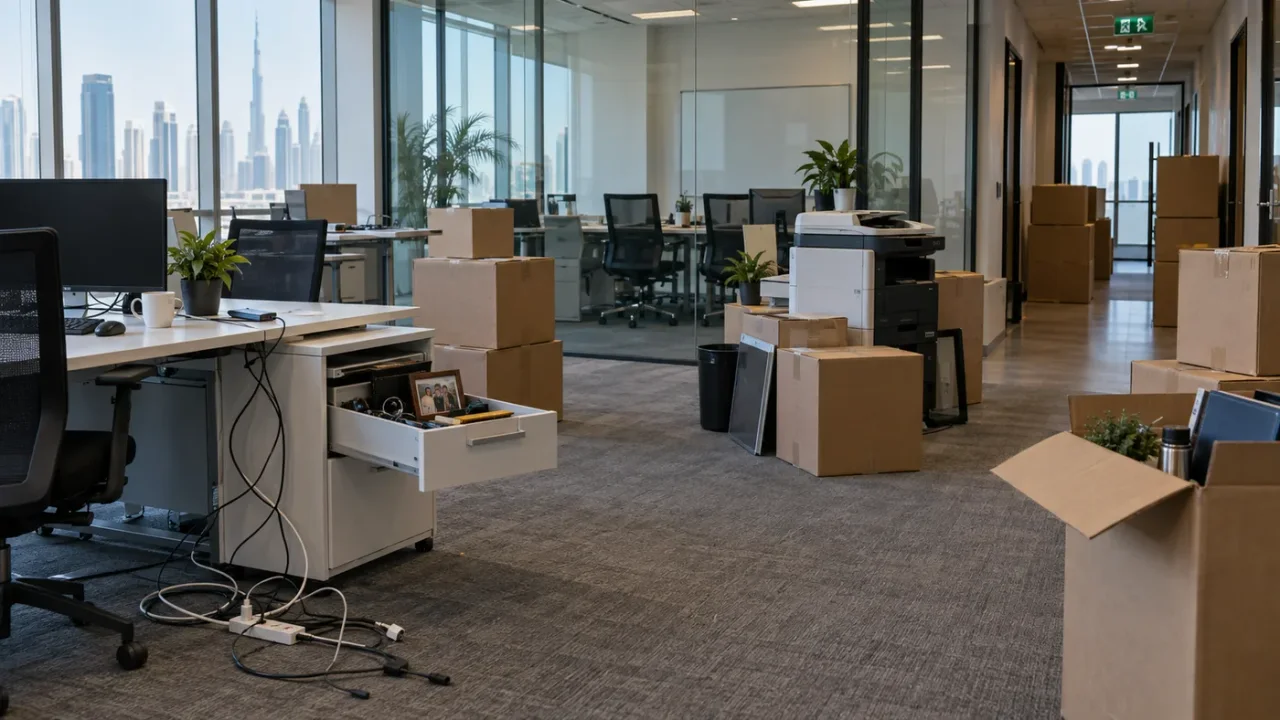
An office refurbishment should begin with a clean boundary between loose contents and contractor work. Desks, chairs, freestanding storage and approved electronics can leave through a planned clearance, while ceilings, fixed wiring, flooring and demolition debris belong to the fit-out team. This guide shows how to empty the usable floor before trades arrive without losing retained or leased assets.
Walk the office with the facilities lead and fit-out contractor before booking removal. Mark what stays, what goes into storage, what returns to a supplier and what the clearance crew collects. A drawing or room schedule is useful, but visible labels on the actual items prevent mistakes during loading.
Loose desks, chairs, meeting tables and freestanding cabinets approved for removal.
Furniture that will return after the refurbishment and needs protected storage.
Landlord fixtures and retained equipment that must not move.
Leased machines requiring supplier collection.
Fixed elements and work-generated debris assigned to the fit-out contractor.
Protect Retained and Returning Assets
Move retained equipment into a locked room outside the work zone or arrange off-site storage before the site becomes dusty. Use numbered labels that match an inventory, not vague notes such as keep. Photograph condition, bag fixings with dismantled furniture and state which room each item returns to.
Return after works: Sound workstations, ergonomic chairs and meeting furniture that suit the new plan.
Relocate: Assets moving to another branch or a temporary project office.
Supplier return: Rented copiers, dispensers, plants and other contracted equipment.
Protected in place: Approved fixed equipment isolated by the refurbishment contractor.
Separate Data, Records and Building Systems
IT staff should disconnect and inventory data-bearing equipment before the furniture crew arrives. Records owners should remove confidential files from cabinets, and the building team should identify controls, access readers or cables that are not part of the clearance. Do not cut a cable because it appears unused.
Use computer disposal guidance for obsolete IT and keep devices away from mixed furniture. Screens, servers and storage drives need protected handling even when they leave on the same day.
Clear Loose Furniture Before Trades Mobilise
The best collection window is after staff and retained assets leave but before contractors bring tools, protection boards and materials onto the floor. Two teams sharing a service corridor create congestion and make responsibility for damage unclear. Finish the loose-content clearance first, inspect the floor, then hand the work zone to the refurbishment team.
Count workstation components before dismantling so reusable sets stay complete.
1Empty desks, cabinets and shared storage.
2Disconnect approved devices and separate data hardware.
3Remove chairs and small freestanding items from the route.
4Dismantle only the agreed reusable or disposable furniture.
5Load large desks, tables and cabinets through the reserved service lift.
6Inspect the empty floor before fit-out access begins.
Keep Clearance and Construction Waste Separate
Clearance stream
Fit-out stream
Loose office furniture
Removed ceilings, flooring and wall finishes
Freestanding cupboards and shelving
Fixed joinery and structural partitions
Approved boxed contents
Plasterboard, timber offcuts and demolition rubble
Separated office electronics
Electrical and mechanical installation waste
The crew collecting office contents should not inherit waste generated by later building work.
This boundary needs to appear in both bookings. Junk Services Dubai handles approved loose contents and furniture, not construction, renovation or demolition debris. If a fit-out contractor removes a fixed element, that contractor remains responsible for the resulting material unless another suitable arrangement is made.
Plan Access and the Final Floor Check
Confirm contractor registration, vehicle access, lift protection and permitted work hours with the building. Offices in DIFC, Business Bay and Dubai Internet City can have different rules even when managed by the same facilities company. Measure the largest furniture after wrapping or dismantling, not only in its installed form.
After loading, check the floor against the keep, store, return and remove list. Record any wall-mounted item left for the fit-out team and photograph the clear route. The next phase should start with no loose junk hidden in store rooms or under raised desks.
Key Takeaways
Agree the boundary between loose contents and fit-out work before booking.
Inventory and protect every asset that will return after refurbishment.
Finish furniture collection before trades bring materials onto the floor.
Keep construction and demolition debris outside the junk-removal scope.
Why Choose Junk Service in Dubai
As a local, fully insured team, Junk Services Dubai makes clearing your space simple — fast pickups, fair upfront pricing and responsible disposal across every Dubai community.
Same-Day Availability
Book today and, where crews are free, we clear it today — with no rush surcharge.
Fair, Upfront Pricing
A flat price agreed before we arrive, based on volume, items and access. No surprises.
Insured, Uniformed Crews
Background-checked teams who do all the lifting and protect your floors, lifts and walls.
Responsible Disposal
We sort for reuse, donation and recycling in line with Dubai Municipality guidance.
Our editorial team is made up of the crews and coordinators who clear homes, villas and offices across Dubai every day. We share practical, first-hand guidance on decluttering, disposal and responsible waste removal in the UAE.
FAQ
Frequently Asked Questions
Approved loose contents such as desks, chairs, freestanding cabinets, boxed clutter and separated electronics can leave. Confirm every category in the written scope.
Safely demountable modular screens may be agreed in advance, but structural walls, bonded panels and demolition work require the appropriate fit-out contractor.
Dismantle them only as much as access requires. Bag and label fixings, photograph the assembly and keep matched components together for reinstallation.
Schedule it after staff, records and retained equipment have moved but before refurbishment contractors occupy the route with tools and materials.
The appointed fit-out contractor should manage construction, renovation and demolition waste under its project arrangements. It is outside ordinary office junk removal.
Usable furniture may be set aside for reuse or donation where a suitable route is available. Decide early so complete sets are not damaged during general loading.
Final Thoughts
Pre-refurbishment clearance works best as a clean handoff. Remove approved loose assets, document what remains and let the fit-out contractor enter an empty, inspected work zone with no confusion over ownership or waste responsibility.
Arrange a Pre-Refurbishment Office Collection
WhatsApp Us the room plan, item photos, keep labels and building access details. We can schedule loose furniture and non-hazardous office-content removal before the fit-out team mobilises.
What an office clearance involves when a lease ends in Dubai: which contents leave and which fittings stay, the handback sequence, how to phase the work around a trading business, and where the service stops.
How to clear unwanted office partitions, acoustic screens and cubicle dividers in Dubai: unbolting modular panels, wire disconnection, lift bookings and tower clearances.
A renovation can't start until the property is empty, and that clearance runs to the contractor's date, not the household's. Here is what gets cleared, what stays firmly out of scope, and how to time it before the crew arrives.

 Guides