 Guides
 4 min read
How to Declutter Your Home in Dubai: A Practical Action Plan
A practical guide to decluttering your Dubai home: sorting rules, managing expatriate accumulation, building momentum, and organizing discard removal.
Read Article
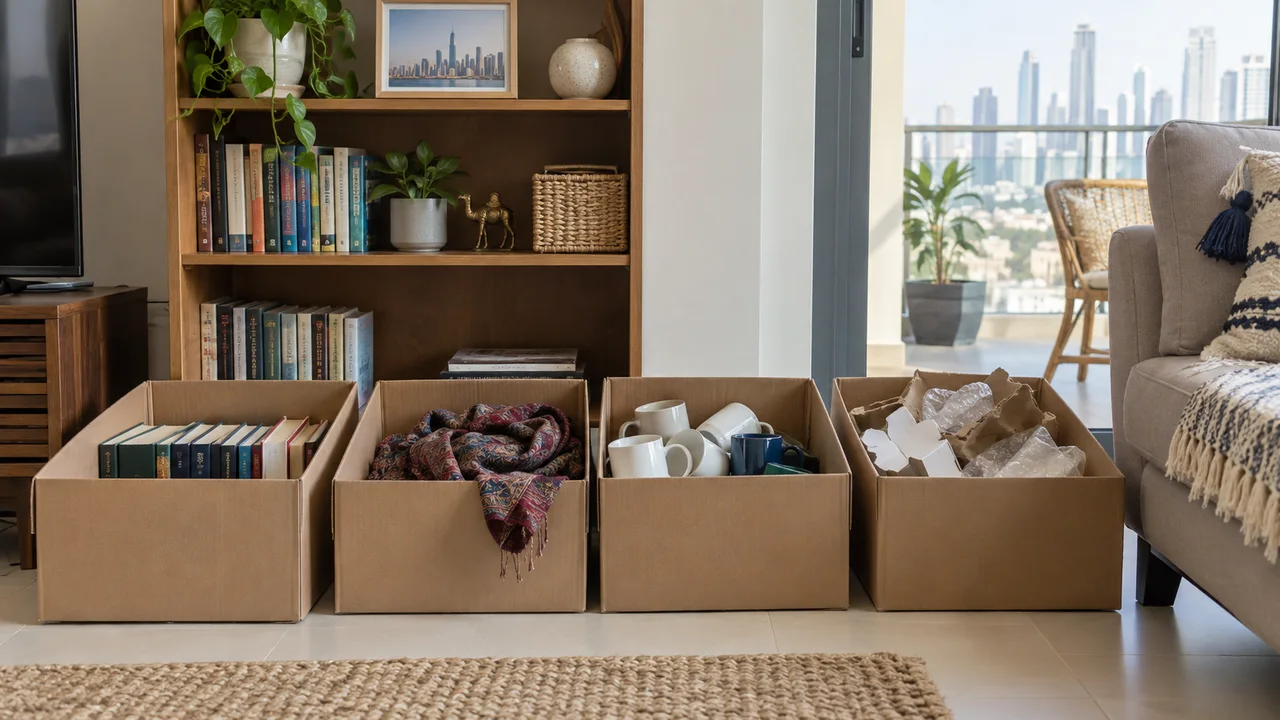
The four-box decluttering method gives each object a destination while you clear a defined area. This guide uses keep here, put elsewhere, pass on and dispose: a practical version that separates misplaced belongings from things you no longer need. It works best when you finish the contents of all four containers before expanding the project to another room.
There are different versions of this method, so agree the labels before starting. In this version, the fourth category adds a distinction often missing from a keep-or-discard sort: some clutter is useful but in the wrong place. A scarf on the kitchen chair needs returning to its home, not a donation decision.
| Box | Decision | Finished when |
|---|---|---|
| Keep here | Useful or valued in this area | Returned to a defined place in the same area |
| Put elsewhere | Still belongs in the home, but not here | Delivered to its actual storage location |
| Pass on | No longer needed and suitable for reuse | Accepted by a recipient and handed over |
| Dispose | Not suitable for the chosen reuse route | Separated and delivered to accepted waste routes |
The general home decluttering guide uses a three-group system. This four-box version is useful when the main obstacle is wandering between rooms to put objects away. Collecting those trips into one short return round keeps the current sorting task contained.
Start with a console, shelf or drawer rather than the entire apartment. Use existing cartons, baskets or trays; the boxes do not need to match. In a small JLT apartment, four compact trays on a table may be more practical than four floor cartons.
One shelf is enough to learn where the decisions stall. If most items enter the put-elsewhere box, storage locations need attention. If pass-on fills but never leaves, the next task is arranging handovers, not clearing more cupboards. The containers make the unfinished work visible.
A doubtful object is not automatically rubbish. Work-owned devices, personal records, valuables and another family member's belongings need their owner's decision. Leave those items in a protected review spot with a question to answer, such as whether a cable belongs to the retained monitor. This is a safeguard, not permission for an unlimited fifth box.
Do not use the method to force quick decisions about chemicals, batteries or damaged electronics. Isolate these items and confirm their handling separately. The decision label dispose never means every material can share one rubbish bag.
Carry the relocation container through the home once sorting ends. Put each object into its proper location rather than leaving the box in another bedroom. If an item has no home, either create a practical one or reconsider whether it earns space. Moving it behind another door has not completed the task.

In a villa in The Springs, it is tempting to send every unresolved object to the garage. Keep the return round tied to actual storage locations. A larger home gives the box more places to disappear, so emptying it matters just as much as it does in a studio.
The pass-on box can contain sale candidates, accepted donations or gifts someone has requested. Keep those destinations identifiable and set a realistic next action for each. A clean appliance with no interested recipient remains your responsibility; calling it a donation does not create a collection booking.
Use the selling decluttered items guide when a sale is worth the time involved. For other goods, the donation preparation guide covers condition and acceptance. Keep matching parts together so a usable set does not become incomplete while it waits.
Choose a deadline you can meet for offering and handing over the items. When it passes, make another explicit decision about their destination. Do not keep extending the deadline while the boxes take over a dining area that the original sort was supposed to restore.
Sort the dispose group by its accepted route: clean packaging, damaged household goods and specialist items cannot automatically travel together. Keep broken or leaking objects away from reusable goods. Ask the collector about uncertain materials before handing over a sealed container whose contents cannot be seen.
For bulky items, arrange junk removal using photographs of the actual load. Confirm the building's lift and loading arrangements, then keep outgoing items inside the home until the collection time. An empty sorting area and completed destinations are a better result than four neatly filled boxes.
At the next session, reuse the same containers and start with a fresh, limited area. If a previous box still contains objects, deal with those first. This completion rule is what turns the method from a way to distribute clutter into a way to finish household decisions.
As a local, fully insured team, Junk Services Dubai makes clearing your space simple — fast pickups, fair upfront pricing and responsible disposal across every Dubai community.
Book today and, where crews are free, we clear it today — with no rush surcharge.
A flat price agreed before we arrive, based on volume, items and access. No surprises.
Background-checked teams who do all the lifting and protect your floors, lifts and walls.
We sort for reuse, donation and recycling in line with Dubai Municipality guidance.
Written by
The Junk Services Dubai Team
Junk Removal Specialists
Our editorial team is made up of the crews and coordinators who clear homes, villas and offices across Dubai every day. We share practical, first-hand guidance on decluttering, disposal and responsible waste removal in the UAE.
No single label set is used everywhere. This guide uses keep here, put elsewhere, pass on and dispose so useful misplaced belongings have their own destination.
Yes. Match the containers to the small area you are sorting. Trays can work better in a compact flat and discourage starting more than you can finish.
Give each item a specific home before calling the session complete. If there is no suitable place, review its purpose rather than moving the whole box into another room.
Yes during the initial sort, but mark or separate their next actions afterward. A sale listing, accepted donation and agreed gift have different handover steps.
Record the decision on an inventory or photograph while the furniture remains in place. Send dimensions and access details to the collection team rather than moving heavy pieces for the sake of the sorting layout.
Pause the sort and complete that box's destination tasks. A full container is a useful limit on the work in progress, not a reason to add more boxes.
Four boxes are useful because they expose four different kinds of unfinished work. Returning a scarf, arranging a donation and booking furniture collection are separate actions even when they began on the same shelf.
Keep the batch small enough to close. The method succeeds when the containers can be reused empty, not when their labels look organised.
When the outgoing load is decided, send photos of the furniture and household items with your area and access details. Our team can confirm what is accepted and the collection price before the visit.
GuidesA practical guide to decluttering your Dubai home: sorting rules, managing expatriate accumulation, building momentum, and organizing discard removal.
Read Article Guides
A practical guide to selling the items you clear out in Dubai: what sells, where to list it, how to price for a fast sale, and when to stop trying and book removal instead.
Read Article Guides
A practical guide to donating what you clear out in Dubai: what charities take, where to drop off or arrange pickup, how to prepare items so they're accepted, and what to do with the rest.
Read Article