The 20/20 Rule for Decluttering: How It Works in Dubai
The Junk Services Dubai Team 5 min read
The 20/20 rule is a quick test for the items people keep just in case: if something could be replaced for under twenty dollars in under twenty minutes, it can usually go. This guide explains where the rule came from, how to run it on a shelf or storeroom in one session, and how to adjust it for Dubai, where replacing an item is a short walk in some neighbourhoods and a long drive in others.
The 20/20 rule was popularised by The Minimalists, Joshua Fields Millburn and Ryan Nicodemus. Their test: anything you are keeping just in case can go if you could replace it for less than 20 dollars in less than 20 minutes from your current location. The point is that the feared 'what if' rarely arrives, and when it does, the cost is small.
The rule targets one specific kind of clutter. It is not about things you use, love or would struggle to replace. It is about the drawer of spare cables, the fourth pair of kitchen scissors and the craft supplies kept for a project that never started.
How to Run the 20/20 Rule in One Session
1Choose one contained area, such as a kitchen drawer, a storeroom shelf or the cupboard under the stairs.
2Take everything out and set aside anything used in the past six months, because those are not just-in-case items.
3For each remaining item, ask two questions: could I buy this again cheaply, and could I have it within about twenty minutes?
4If both answers are yes and the item is not in an excluded group, it leaves.
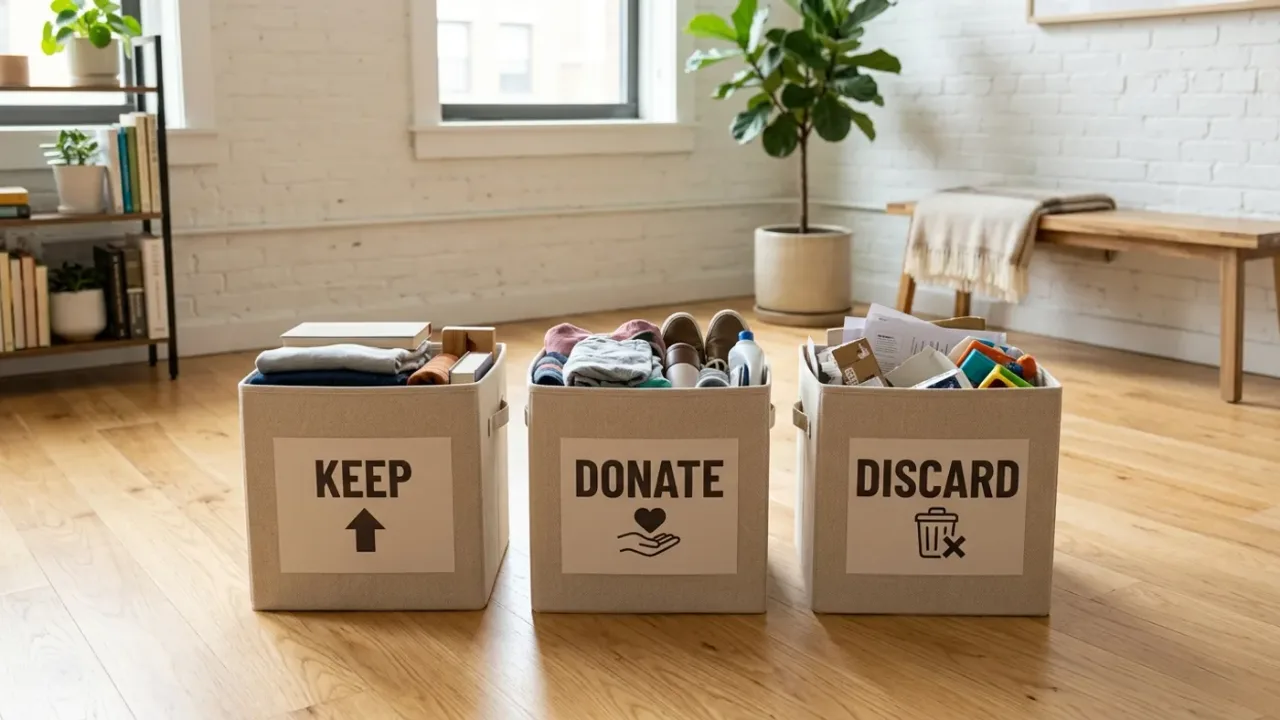
5Sort what leaves into donate, recycle and rubbish before the session ends, so nothing drifts back onto the shelf.
Most people find the time question harder than the price question. Be honest about travel time and about how often the item was needed before. A spare extension lead used once in three years passes easily; a specialist tool used every summer does not.
Adjusting the Time and Price Limits for Dubai
The original figures are in US dollars and assume an American town. Treat both numbers as a starting point, and set a local price limit that feels small for your household instead of converting the figure exactly.
Home situation
Is twenty minutes realistic?
Sensible adjustment
Tower in a dense district such as Business Bay, JLT or Dubai Marina
Often, with supermarkets and pharmacies in the building or close by
Use the rule as written
Villa community further from shops, such as Arabian Ranches or Dubai South
Harder by car, though many areas have fast delivery
Count delivery time, or stretch to the next planned shopping trip
Items usually bought abroad or shipped from overseas
No, as shipping can take days or weeks
Exclude them from the rule
Items needed at short notice, such as a spare work charger
Depends on the time of day
Keep one spare and let the rest go
The rule works where replacement is easy. Where it is not, adjust the time limit rather than abandoning the test.
Season matters too. A twenty-minute errand in August heat is a bigger ask than the same trip in January, and many residents travel for weeks in the hottest months. Allow for that with items you would need while the household is away or when going out is uncomfortable.
Items the 20/20 Rule Handles Well
Cables and chargers: Duplicate USB cables, chargers for devices you no longer own and spare adapters. Keep one of each type in use.
Kitchen extras: Second and third can openers, food containers without lids, surplus utensils and single-use gadgets.
Bathroom and cleaning backups: Stockpiled toiletries and cleaning products beyond one sealed backup each.
Stationery and craft supplies: Dried pens, excess notebooks and materials bought for projects that never began.
Packaging: Gift bags, bubble wrap and cardboard boxes saved for a parcel or a move with no date.
If a move is already booked for the next few weeks, keep the boxes. The rule is for a vague future, not a planned one. Our kitchen decluttering guide goes further on utensils, containers and duplicate appliances.
When Not to Use the 20/20 Rule
The rule is a filter for low-risk items. It fails whenever the cost of being without something is higher than its price.
Safety and emergency items, such as a first-aid kit, a torch or a fire blanket.
Medicines, prescriptions and anything medical.
Documents, keys, ID cards and warranty papers.
Sentimental items, which need a slower process of their own.
Spare parts matching furniture or appliances you still own, such as flat-pack fittings, since exact replacements are often hard to find.
Items for a known upcoming use, such as supplies for a trip already booked.
Things that are cheap but hard to source locally, such as a specific plug adapter or an imported spare.
When in doubt, fill a small holding box and write a date on it three months ahead. If nothing from the box has been used by that date, it goes without reopening the debate.
Making Sure the Rule Does Not Create Waste
Letting go of cheap items only helps if they do not become landfill followed by a repeat purchase. Working items should go to reuse first: a neighbour, a building group, a charity or a donation drive. Our guide to donating decluttered items explains how to prepare them.
Sorting into keep, donate and discard during the session stops cheap duplicates going straight into the bin.
The rule also changes how a household shops. Once everyone sees how easily things can be replaced, there is less reason to buy extras in bulk just in case, which is where the rule saves money over time.
Larger just-in-case items, such as spare furniture, broken fans or shelving kept for later, fall outside the price limit, but the same honesty applies. When a storeroom or villa garage is full of them, junk removal can collect the bulky pieces together once the decisions are made.
Using the 20/20 Rule With Other Decluttering Methods
The rule works well alongside other methods. The four-box method gives a session its structure, the 20/20 rule settles just-in-case items quickly, and a one-in, one-out habit stops duplicates returning. The KonMari method asks a different question, whether an item sparks joy, and suits clothes and books better than cables.
Key Takeaways
The 20/20 rule covers just-in-case items that are cheap and quick to replace.
Set a small local price limit instead of converting the original dollar figure exactly.
Adjust the time limit for villa communities and exclude items bought from abroad.
Never apply the rule to safety items, medicines, documents, sentimental pieces or matching spare parts.
Send working items to reuse so the rule reduces waste rather than moving it.
Why Choose Junk Service in Dubai
As a local, fully insured team, Junk Services Dubai makes clearing your space simple — fast pickups, fair upfront pricing and responsible disposal across every Dubai community.
Same-Day Availability
Book today and, where crews are free, we clear it today — with no rush surcharge.
Fair, Upfront Pricing
A flat price agreed before we arrive, based on volume, items and access. No surprises.
Insured, Uniformed Crews
Background-checked teams who do all the lifting and protect your floors, lifts and walls.
Responsible Disposal
We sort for reuse, donation and recycling in line with Dubai Municipality guidance.
Our editorial team is made up of the crews and coordinators who clear homes, villas and offices across Dubai every day. We share practical, first-hand guidance on decluttering, disposal and responsible waste removal in the UAE.
FAQ
Frequently Asked Questions
The 20/20 rule was popularised by The Minimalists, Joshua Fields Millburn and Ryan Nicodemus, as a way to let go of items kept only in case they might be needed.
Yes. Treat the price as a small amount your household would not mind spending again rather than an exact conversion. The idea is low cost, not a precise figure.
Replace it. The rule accepts that this will happen occasionally, and the small cost is usually lower than the space and effort of storing many rarely used items.
It suits spare basics such as extra socks or plain T-shirts, but most clothing decisions depend on fit and use. A dedicated wardrobe session works better for the rest.
It can be if working items go straight in the bin. Donate or pass on anything usable, and buy fewer duplicates afterwards so the rule reduces consumption.
Yes, for surplus stationery, cables and duplicate supplies. Leave equipment, records and shared items to whoever manages them.
Final Thoughts
The 20/20 rule is useful because it swaps a vague worry for two concrete questions. Use it on the drawers and shelves full of duplicates, keep the exclusions firm, and let the few items that fail the test stay without guilt.
Schedule a Pickup for the Larger Items
When a declutter leaves bulky items behind, from old shelving to boxed garage overflow, WhatsApp Us photographs and your area. Our team will confirm what can be collected and a suitable time.
Use four clear destinations to finish a small decluttering session: keep here, put elsewhere, pass on and dispose. Learn how to empty the boxes without creating new piles.
Understand Marie Kondo's category order and keep-first approach, then plan a practical tidying project around your Dubai home's space, ownership and collection needs.
How to declutter Dubai apartments with limited storage. Clear living spaces without external lockers, set container boundaries, and maximize vertical space.

 Guides