Office Downsizing Clearance in Dubai: Keep, Move or Remove
The Junk Services Dubai Team 5 min read
Office downsizing is a space-planning decision before it becomes a removal job. A smaller Dubai workplace may need fewer desks, chairs, cabinets and meeting tables, but records, leased equipment and reusable assets cannot enter one undifferentiated clearance pile. This guide shows how to match the inventory to the new floor plan, choose a destination for every surplus item and clear the excess without disrupting the team that remains.
Start With the Smaller Floor Plan, Not the Old Inventory
Count what the future office can use before deciding what is surplus. Confirm the number of assigned desks, shared workpoints, meeting seats, storage runs and reception pieces in the approved plan. A chair is not excess merely because its present desk is closing; it may be needed in a meeting room or project area after the move.
Record dimensions as well as quantities. A wide executive desk may fit the headcount calculation but fail the new room layout, while compact bench desks may be reusable in a different arrangement. The broader office relocation junk-removal guide covers what stays behind during a move; downsizing adds the harder step of deciding what the reduced operation still needs.
Asset group
Downsizing question
Likely destination
Workstations
How many fit the approved seating plan?
Retain complete sets; remove unmatched surplus
Task chairs
Are condition and adjustments suitable for daily use?
Retain best units; reuse, sell or recycle the rest
Meeting furniture
Which room sizes remain?
Match tables and chairs to each retained room
Storage
What must stay physical after the records review?
Keep only the capacity tied to approved records
Electronics
Is each device assigned and data-cleared?
Redeploy, return to supplier or route as e-waste
The new operating plan should determine the retained inventory, not the other way around.
Give Every Surplus Asset One Clear Destination
Use a destination code that can be understood without a manager standing beside it. Keep, move, supplier return, sell, donate, recycle and remove are different instructions. A single surplus label hides ownership and condition decisions that must be settled before loading begins.
Retain: Assets assigned to the smaller office, another branch or an approved storage location.
Return: Copiers, dispensers, plants and other equipment owned by a supplier or landlord.
Resell or reuse: Complete, sound furniture with enough time to find a recipient before the deadline.
Recycle: Separated metal frames, electronics and other recoverable materials that are no longer usable.
Remove: Broken, incomplete or rejected non-hazardous office contents approved for collection.
Set a decision deadline. Resale and donation need lead time, and neither route should hold up a lease handover. Our guides to selling used office furniture and donating old office furniture explain how condition and complete sets affect those options.
Protect Records, Data and Supplier-Owned Equipment
Furniture counts can move quickly, but records and IT need named owners. Records staff should approve retention or destruction before filing cabinets are emptied. IT should back up required data, remove accounts, inventory devices and decide the route for drives, computers, screens and phones. A clearance crew should never make those decisions from what appears old.
Check asset labels against the company register before moving devices.
Keep confidential paper and data-bearing hardware outside the general furniture stream.
Arrange supplier collection for rented equipment before the final clearance window.
Empty lockers and pedestals under a documented staff deadline.
Retain keys and fixings with any cabinet or desk that will be reused.
Use the office electronics data-destruction guide for obsolete devices. Batteries, lamps, liquids and other specialist materials also need their own route rather than being hidden inside drawers or cartons.
Stage Surplus Without Disrupting the Remaining Team
A downsizing often happens while part of the office remains active. Choose a staging area away from occupied desks, fire equipment and escape routes. Keep retained assets in place until their destination is ready, and move only approved surplus into the collection zone so the floor does not become a maze of mixed furniture.
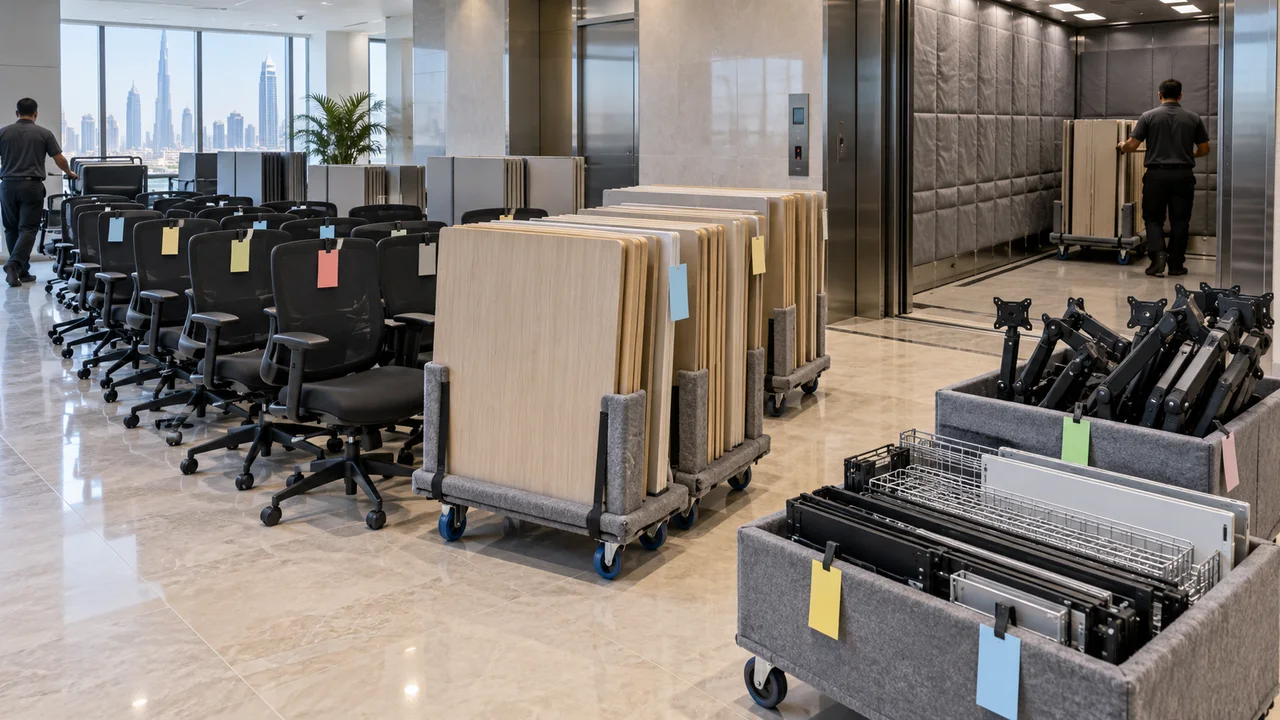
Group complete furniture sets and reusable components by destination before the collection window.
1Freeze the retained seating and room plan.
2Photograph and count surplus assets by type and condition.
3Remove records, personal items and data equipment from furniture.
4Apply visible destination labels and resolve every unlabelled item.
5Stage the approved load without blocking active work or safety routes.
6Walk the floor after collection and reconcile the retained inventory.
Book the Building Route Around the Business Schedule
Commercial towers in Business Bay, DIFC, JLT and Dubai Internet City may control contractor access, loading bays and service-lift windows. Confirm the building's requirements before promising an internal deadline. The collection plan should state vehicle access, floor protection, lift padding, permitted hours and the contact who can approve a last-minute item query.
Large desk runs and meeting tables may need dismantling even when they are being reused. Photograph connections, bag fixings and keep matching frames and tops together. For a larger mixed load, a planned commercial junk-removal collection keeps labour, vehicle space and the access window aligned.
What Changes the Collection Time and Cost
Price and duration depend on volume, dismantling, carrying distance, lift access, loading restrictions and the number of separate material streams. Fifty loose chairs can load faster than ten linked workstations that need cable trays and shared frames removed. An accurate photo inventory should show both the assets and the route from the floor to the vehicle.
Count large items and estimate cartons rather than describing the job as half an office.
Show bolted desk runs, glass tops and unusually heavy pieces in separate photos.
State the floor, lift reservation and loading-bay distance.
Identify items leaving for different destinations or requiring protected handling.
Confirm whether the team will remain operational during collection.
Finish With a Retained-Asset Check
After loading, compare the remaining floor with the approved smaller plan. Check every store room, meeting room, pedestal and cabinet, then confirm that complete retained sets still have their fixings, keys and accessories. Photograph the cleared zones and note any disputed or specialist item left in place.
The goal is not an empty office unless the lease is ending. It is a right-sized workplace with no unexplained surplus, no lost business asset and no clearance pile left for staff to revisit later.
Key Takeaways
Let the approved smaller floor plan set the retained quantities.
Give each surplus asset one visible destination before loading.
Keep records, data devices and supplier-owned equipment out of the furniture stream.
Reconcile the remaining inventory after collection rather than aiming for an empty floor.
Why Choose Junk Service in Dubai
As a local, fully insured team, Junk Services Dubai makes clearing your space simple — fast pickups, fair upfront pricing and responsible disposal across every Dubai community.
Same-Day Availability
Book today and, where crews are free, we clear it today — with no rush surcharge.
Fair, Upfront Pricing
A flat price agreed before we arrive, based on volume, items and access. No surprises.
Insured, Uniformed Crews
Background-checked teams who do all the lifting and protect your floors, lifts and walls.
Responsible Disposal
We sort for reuse, donation and recycling in line with Dubai Municipality guidance.
Our editorial team is made up of the crews and coordinators who clear homes, villas and offices across Dubai every day. We share practical, first-hand guidance on decluttering, disposal and responsible waste removal in the UAE.
FAQ
Frequently Asked Questions
Start the asset audit as soon as the smaller floor plan and headcount are approved. Early decisions leave time for supplier returns, resale and reuse before the collection deadline.
Yes, if the job has a separated staging area, protected route and controlled collection window. Active desks and safety routes must remain clear.
Retain the best chairs needed by the new seating plan, then assess complete usable units for reuse or sale. Worn or broken chairs should be separated for material recovery or approved disposal.
Computers can leave during the same project, but they need a separate inventory and data-approved route. Do not load unreviewed devices with general furniture.
Pricing depends on the approved volume, dismantling, access, labour and handling requirements. Photos, counts and building details allow the collection scope to be set before arrival.
Yes, if the destination is confirmed and the items are labelled for relocation. Keep matched parts, keys and fixings together so the receiving branch gets complete usable sets.
Final Thoughts
A successful downsizing leaves a smaller operation properly equipped, not a floor stripped without a plan. Match assets to the new layout, protect information and ownership, then remove only the approved surplus through a controlled building route.
Arrange Collection for Surplus Office Assets
WhatsApp Us the floor plan, item counts, photos and building access details. We can schedule collection of approved furniture and non-hazardous office contents around your downsizing programme.
What an office clearance involves when a lease ends in Dubai: which contents leave and which fittings stay, the handback sequence, how to phase the work around a trading business, and where the service stops.
A relocation creates two clearances, not one: the surplus that never travels to the new office, and the packing debris left behind after it does. How to sequence both around moving day in Dubai.
Office furniture is some of the easiest material in a building to keep out of landfill, because it is uniform: metal frames, laminate panels, foam and fabric, repeated across dozens of identical pieces. Here is what a sorted, sustainable disposal involves.


 Guides